July 12 - Espresso and Epics - Tools To Run Great Games
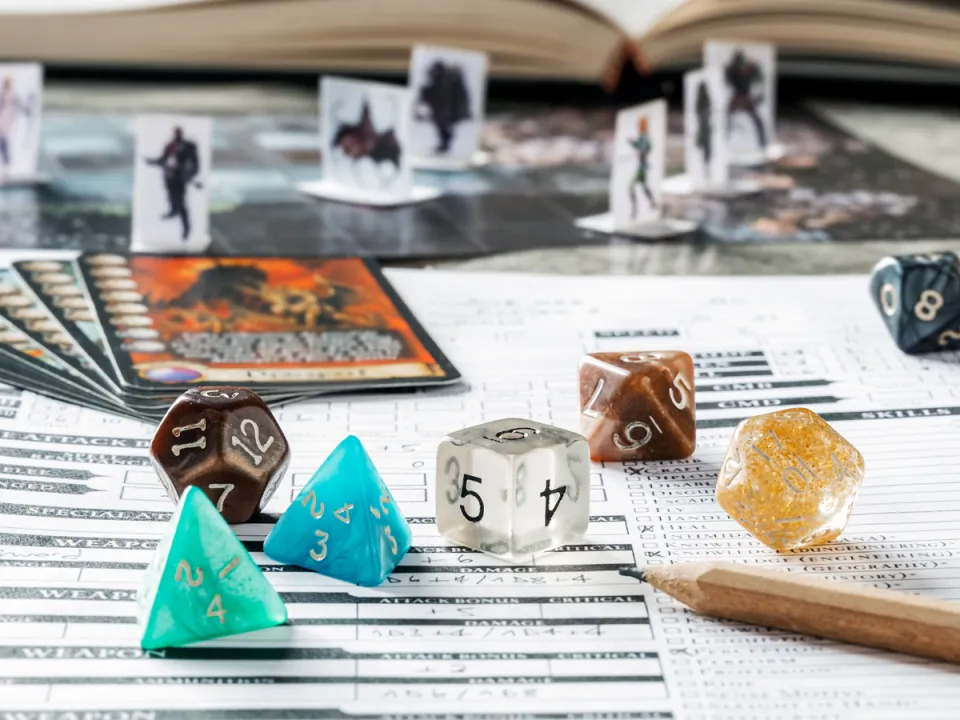
Join us at our Espresso and Epics Event on Sunday, July 12th at Meanwhile Coffee in Herndon to play a Oneshot Game. Or the following Wednesdays at the Reston Community Center!
Sign up on our discord and say hi!
Espresso and Epics - 1PM, Sunday, July 12th at Meanwhile Coffee
Reston Plays Games - 6PM, Wednesday, July 15th and July 22nd at the Reston Community Center
The Game:
We are taking one of the Gooey Cube's One Shot Adventures for D&D and running it this Sunday!
The Dungeon of Du'unix
Something dark stirs beneath Mu'uz Derron - a corrupted mountain looming over the wasteland known as the Deadhills. A previous expedition went in seeking lost treasures and ancient magic. Only one came back, and not for long. Two desperate benefactors need a new group of adventurers brave (or foolish) enough to descend into the ruins and find out what's really down there. Bring your dice, your level 8 characters, and a taste for danger — the Deadhills don't forgive mistakes.
Pre-Generated Characters will be provided!
Overview
There are thousands of TTRPG tools and accessories.. Spend ten minutes browsing and you'll find custom dice towers, laser-cut initiative trackers, hand-painted terrain, subscription battle-map libraries, ambient soundscape apps, and boxed sets that weigh more than a toddler. It's a lot, and if you're new to running games, it's easy to walk away thinking you need a shopping cart full of stuff before you can sit down and tell a good story.
Short Answer: You don't.
This one is for the new GMs, and for the veterans who want a reminder of where the magic actually lives. The truth is that every TTRPG ever made can be run with a handful of things that fit in a backpack, and learning to run a great game with just those things is the single best foundation you can build. Everything else is a layer you add once you know what your table actually wants.
Sooooooo - let's start at the bottom and build up.
The Kit That Runs Any Game
Here's the whole starting list:
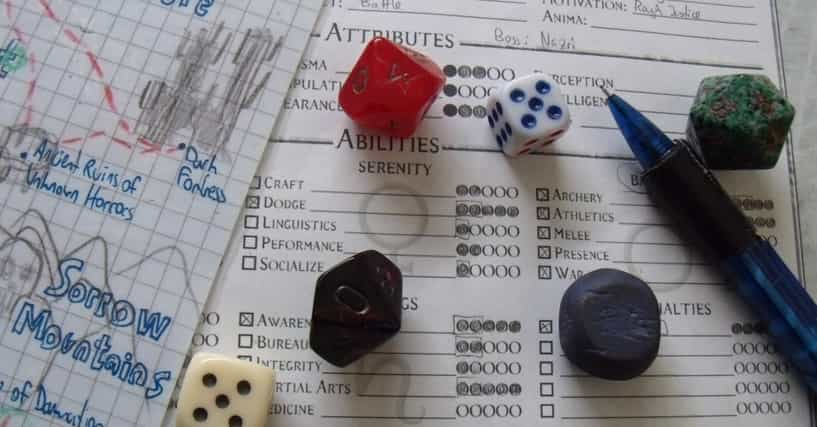
Paper. Post-its. Pencils. Dice. Character sheets. A whiteboard or some kind of mapping surface. A few figurines or tokens for position reference, if your game leans on a battlemap. And the rulebooks for whatever system you're playing.
That's it. That's the table.
Every game in the hobby, from the crunchiest tactical dungeon crawl to the loosest narrative one-shot, can be run with that pile. Paper and a pencil hold your notes, your initiative order, and the name of the innkeeper you frantically invented on the spot. Post-its are the most underrated tool in gaming - NPC names, standing conditions, a quick sketch of who's standing where, all of it, movable and disposable. The whiteboard becomes your dungeon, a tavern, a clever ambush site, or just an easy to use surface for everyone to quickly draw on. Tokens tell everyone where they are when words start getting tangled.
I always recommend new GMs to get genuinely comfortable here before reaching for anything fancier. Not because the fancier stuff is bad, but because running lean teaches you what actually matters at your table. When the only tool you have is a description, you learn to describe. When the only map is a whiteboard scribble, you learn which details are worth drawing and which ones you can let the players imagine. You start to notice the gaps, and those gaps will be the honest signal you'll ever get about what belongs at your table next. You learn to play it your way, and then you learn what could help fill in the gaps.
A Picture is Worth A Thousand Words
Once the basics feel natural, the first real upgrade is going to be your preparation, and specifically the kind of preparation that helps your players see the world instead of just hearing about it.
Three things do most of the heavy lifting here.
First, prepared descriptions - A few sentences written ahead of time for the places and moments you know are coming, so that when the party pushes open the door to the throne room, you're reading something evocative instead of scrambling. Don't script the whole game, but you should have a handful of ready-to-go paragraphs for the beats that matter.
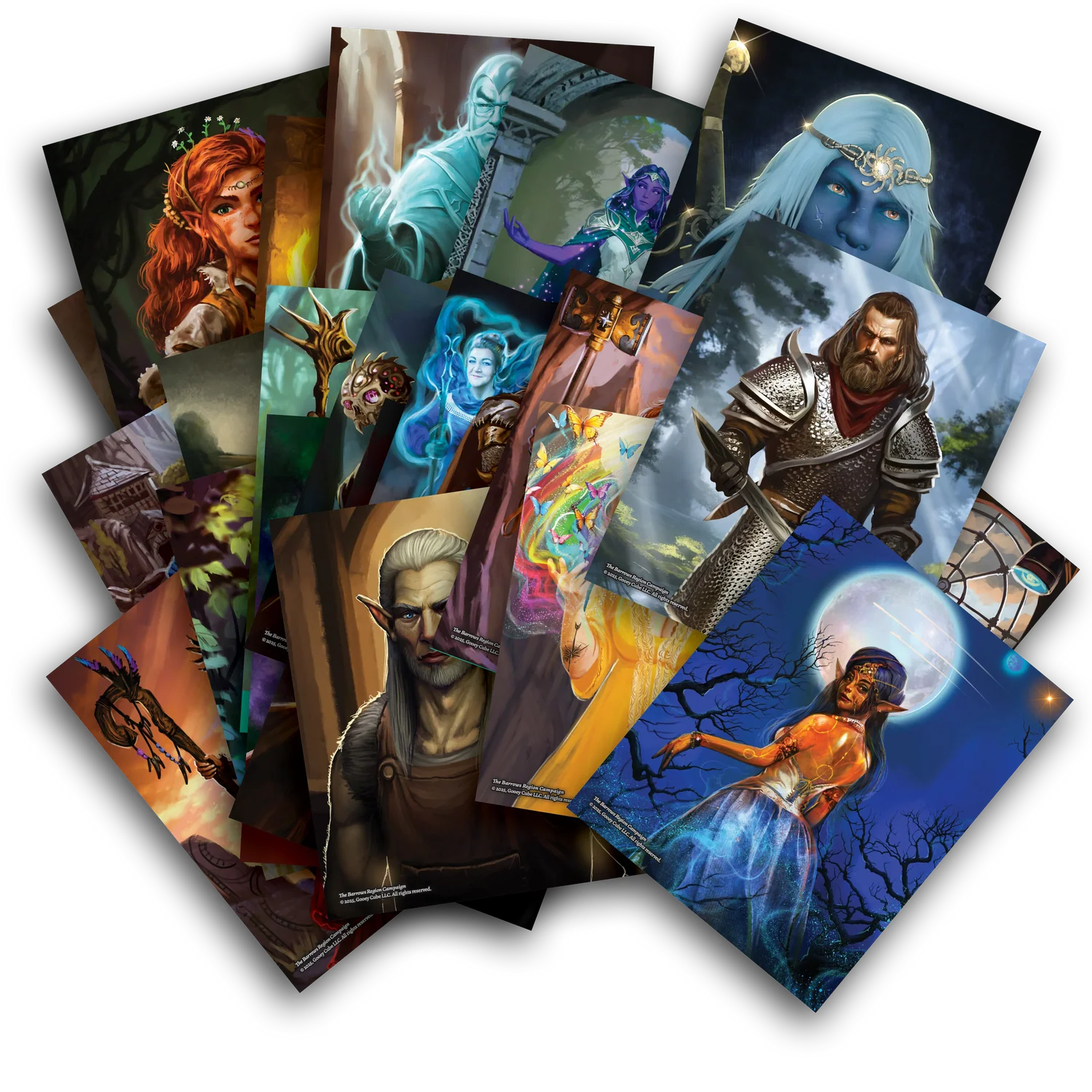
Second, small portraits of the important NPCs - A single image of the grizzled captain, the nervous merchant, the villain smiling behind the curtain. When you slide a face across the table, that character becomes a person the players will remember. People always connect to someone they can look at.
Third, maps and images of the scenes and events your story runs through. The burning village. The vault they've been chasing. The map of the region they're deciding how to cross. These give players context they can hold onto, and they turn "you arrive at the ruined keep" into something the whole table is looking at together.
"A picture is worth a thousand words" is worth every bit of the cliché here. A good description sets the scene, but a simple image can anchor it. Together they do the thing every GM is actually chasing, which is getting the players to care about who and what they're interacting with. That's the whole game, really - everything else is just extra.
And notice what's not on this list yet: no synced digital maps, no ambient music playlist, no campaign wiki with cross-linked lore entries. All of these can absolutely make a great experience even greater. But it's a lot of complexity to take on before you know your own style.
I gently steer new GMs to build up to them.
Learn what your table responds to first. Some groups light up at a swelling soundtrack. Others find it distracting and just want to hear you talk. You find out by adding one thing at a time, not by buying the whole ecosystem on day one.
The Books Do the Work for You
Here's the good news for anyone who reads all that and thinks "that sounds like a lot of prep." You often don't have to do it all yourself.
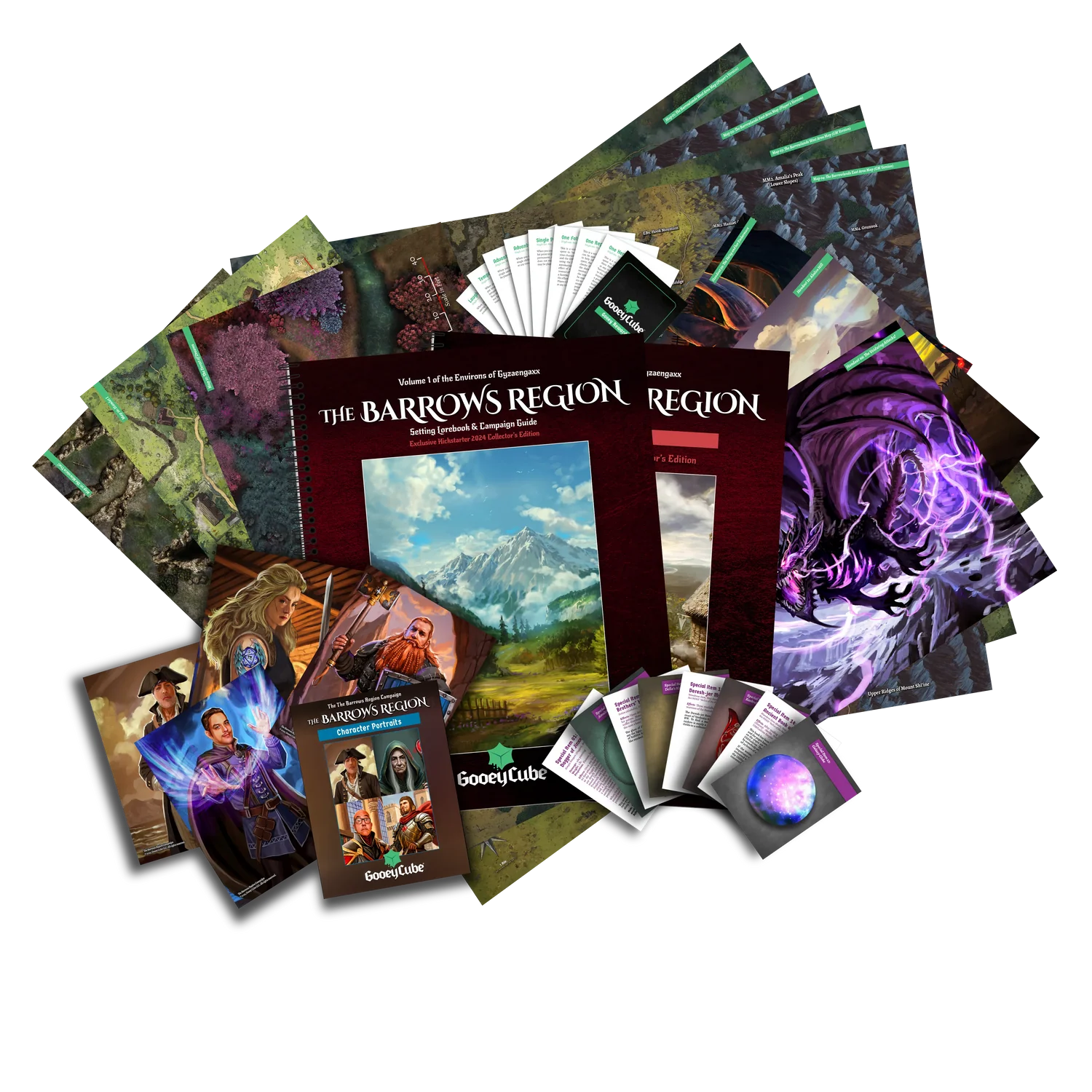
A ton of published adventures already come loaded with exactly this kind of material. I always recommend finding some adventure or story that interests you and start running your first game using that. Many modern campaign books ship with digital versions of their maps, handouts, and art, sometimes as a bundled PDF pack, sometimes as a code you redeem online. Some come with physical printouts right in the book or box. The whole point is to let you pull an image, a description, or a character straight out of the product and put it in front of your players, no design skills required.
The sweet spot for a lot of GMs is not building the visual layer from scratch, but just using the one the publisher already made. Print the map. Slide existing NPC art across the table. Read the boxed description. You get everything you need with a fraction of the work.
And finally... there's the next tier up. Where you find the companies that exist to do the breakout work for you.
The Grander Scale
Some products hand you everything in a box. Others are built, from the ground up, to take the raw material of a great adventure and split it out into ready-to-use pieces so you don't have to. Two companies are worth pointing at here, partly because they're excellent and partly because they came from exactly the impulse this whole article is about.
Both Gooey Cube and Beadle & Grimm's emerged in that 2018-2019 window, in the wake of 5E's enormous success. It became clear that a huge new wave of GMs and players could use tools and extras to help them run great games. The founders of Beadle & Grimm had been playing together for decades, and noticed that Dungeon Masters lacked tangible, high-quality props and immersion materials to run their campaigns. They turned their shared hobby into a company to design premium, in-world artifacts, detailed maps, handy handouts, and curated accessories for the tabletop RPG community.
Gooey Cube is the clean example of "everything you need, straight out of the box." Their world of Zyathé is a 5E-compatible dark fantasy setting, and their boxes are engineered specifically to save GMs hours of session prep. Open one up and you get full-color DM and player maps for every area, floorplans for individual locations, dozens of full-page scene handouts, a deep deck of illustrated NPC portrait cards with a quick bio and description on the back, item cards, and layered books of lore and GM guidance. My favorite piece of their design is the "Not-So-Random-Encounter," this isn't a rigid combat block, but more a selection of location-based encounter ideas a GM can grab and shape. By including difficulty guidance that isn't hard-locked to character level, it gives the GM options. Their flagship campaign, Red Star Rising, is one of the best examples of everything that can save a GM hours of time. Once the players have made their characters, nearly everything you need to run the game is ready in the box.
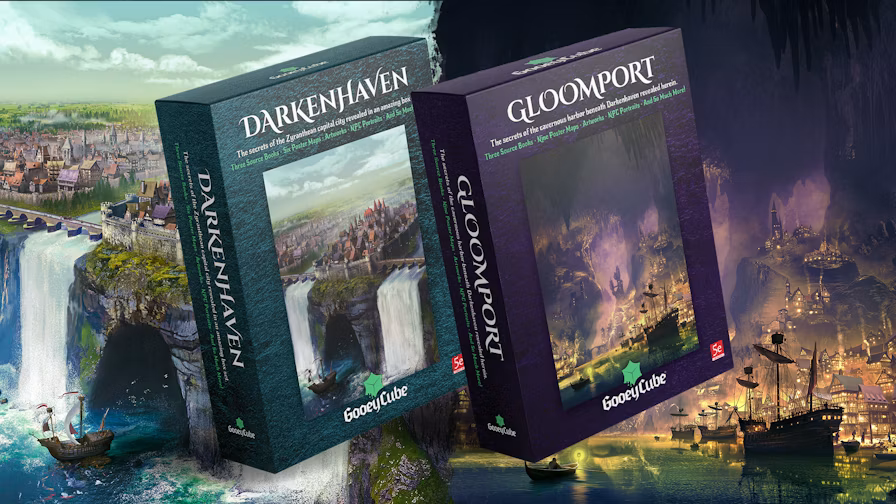
Gooey Cube has a Backerkit campaign going on right now for their massive box sets of Darkenhaven and Gloomport - a sprawling metropolis and the immense underground seaport city that lies beneath...
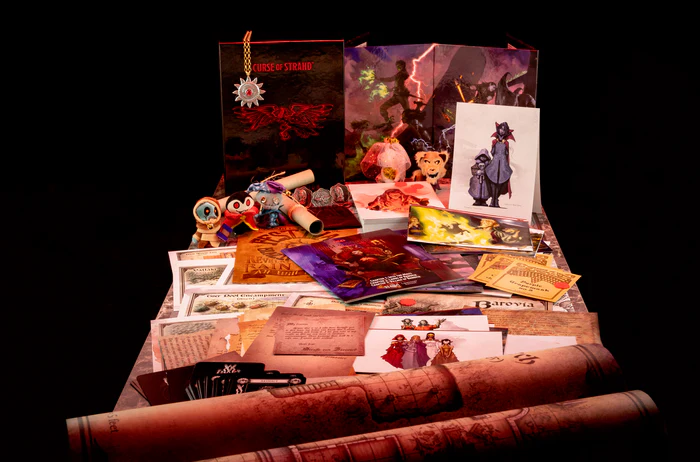
Beadle & Grimm's takes existing published adventures and blows them up into premium boxed experiences. Their treatments of Ravenloft: The Horrors Within material, and the Curse of Strahd Legendary Edition, are genuinely stunning: dozens of oversized battle maps, the adventure split into slim lay-flat booklets that are far easier to manage behind a screen than a giant hardback, encounter cards with art on one side and DM info on the other, a custom DM screen, pre-gen characters, bonus side adventures, and a small mountain of in-world artifacts, from deed scrolls and wax-sealed letters to actual finger puppets. I've always admired their work, and found it to be a love letter to the hobby.
What these companies actually provide, underneath the shrink wrap, is the exact list we built up to: maps, portraits, scenes, descriptions, pre-made encounters, and general guidance on how a story can run. All of it setup to give the GM room to adapt the content to their own table.
You Don't Need Any of It (But It's Nice)
Here's the part I want to land, because it's the whole reason for writing this.
You do not need a Beadle & Grimm's box to run an amazing Curse of Strahd. You can run Strahd with the core book, a pencil, and a few well-chosen printouts - your players will be terrified and delighted all the same. The Legendary Edition is a spectacular way to elevate that experience, but the experience was always available to you for the price of the module.
The same goes for everything above the baseline. A premium set, a subscription, a third-party toolkit... they all cost money. Sometimes that cost buys back hours of your life and lands beautifully at your table. And sometimes it buys a gorgeous product that sits on a shelf because it never actually fit how you like to run games.
That's the mistake I most want new GMs to avoid: don't go buy a pile of tools and accessories before you know whether you'll use them, or how they fit your normal playstyle. Start with pen, paper, and a whiteboard. Add prepared descriptions and a few faces once that feels easy. Reach for a publisher's built-in handouts when your story calls for them. And then, once you actually know what your table lights up for, go find the box, toolkit, or the app that scratches that specific itch. That's how you spend money on the thing you'll love instead of the thing you thought you were supposed to want.
Because... when you strip all of it away, the maps and the portraits and the finger puppets included, what's left is a handful of people at a table telling a story together. That has always been the game. Everything else is just a nice way to help everyone see it.
Now go run something. You already have what you need.
Collectible Pin
If you are local, or in the area, come roll some dice with us and get this guy!
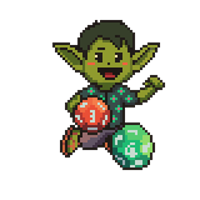
1 x Limited Series 2 Gaming Goblin Pin for Attendees that purchase a drink.
Buy any drink during the event and receive a free Limited Series 2 Pin featuring our smiling Goblin mascot - yours to wear proudly as an adventurer of Espressos & Epics.
Member discussion